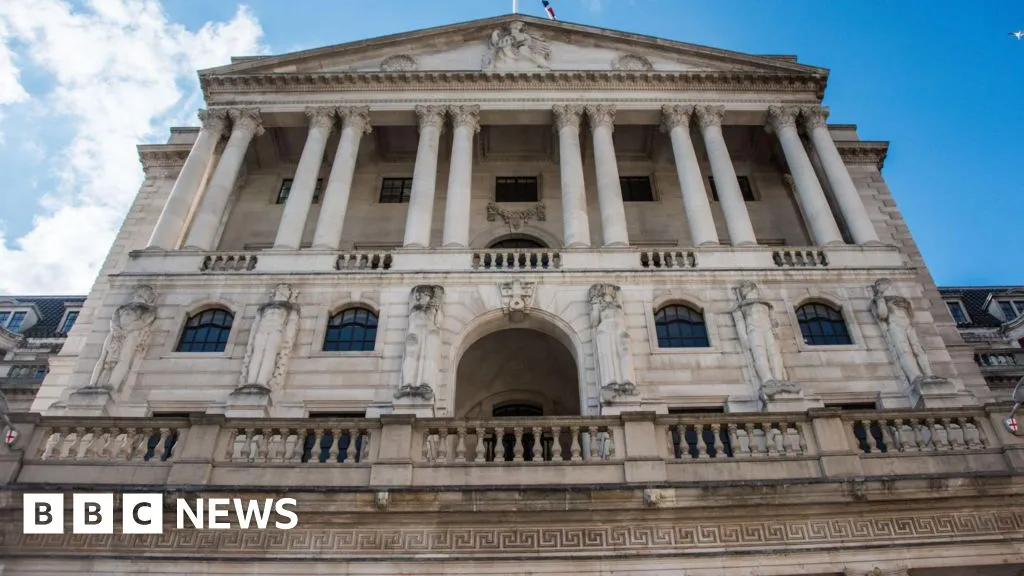
The Bank of England (BoE) is poised to keep its benchmark interest rate steady at 3.75% for a fourth consecutive meeting as global economic tensions, particularly from the ongoing conflict in the Middle East, continue to play a significant role in inflation dynamics.
Market analysts broadly predict that the Monetary Policy Committee (MPC) will abstain from any changes during its meeting set for Thursday at 12:00 BST. Inflation in the UK has remained above target but has not surged as dramatically as anticipated in light of the US-Israel war with Iran and its cascading effects on global economies.
Recent statistics released on Wednesday by the Office for National Statistics indicate that UK inflation held steady at 2.8% for the year leading to May, bolstered by a surprising slowdown in food price inflation, which has touched a 17-month low. Transport costs were noted as the steepest rising category, while prices for meat, dairy, and vegetables saw moderate increases.
With the latest inflation figures falling below expectations, there is growing confidence that BoE policymakers may opt against increasing interest rates in their forthcoming announcement. During the previous MPC meeting in April, the committee had flagged potential rate hikes this year, primarily as a response to significant spikes in energy prices attributed to geopolitical instability.
However, the horizon appears somewhat brighter following a peace agreement between the US and Iran, announced on Wednesday. This deal is expected to facilitate the reopening of the crucial Strait of Hormuz, fostering expectations of a drop in oil prices and potentially alleviating inflationary pressures.
As oil prices have already dipped to their lowest point since the onset of hostilities, traders are optimistic about a smoother flow of oil and gas supplies through this vital channel, which normally accounts for a fifth of the world's energy transport.
Nevertheless, experts caution that the economic environment remains unstable, with a prediction for increased price rises in the UK despite the easing energy crisis. Victoria Scholar, head of investment for Interactive Investor, noted, "UK inflation is expected to rise over the summer after the next Ofgem price cap adjustment in July, which could signal peak inflation. For now, this data seems like the calm before the storm."
Households across the UK are bracing for higher energy costs, with the energy regulator Ofgem announcing a 13% increase in its price cap set for July. This factor underscores concerns that, despite current relief from energy prices, the worst may not yet be over for UK consumers.
As things stand, analysts are divided on whether the BoE will implement any further increases to the benchmark interest rate this year. Comparatively, the European Central Bank recently chose to raise its rates for the first time in almost three years, citing the inflationary impacts of the ongoing conflict.
The BoE's base rate significantly influences borrowing costs, shaping mortgage rates and savings interest for consumers throughout the UK. As of mid-June, the average rate for a two-year fixed mortgage stands at 5.60%, reflecting a notable increase from 4.83% at the beginning of March when the conflict began. Five-year fixed mortgage rates have similarly risen, now averaging 5.57%.
In this climate of uncertainty, all eyes will be on the upcoming MPC meeting as the Bank navigates the complexities of domestic inflation amid global economic challenges.
Source: BBC News - Business