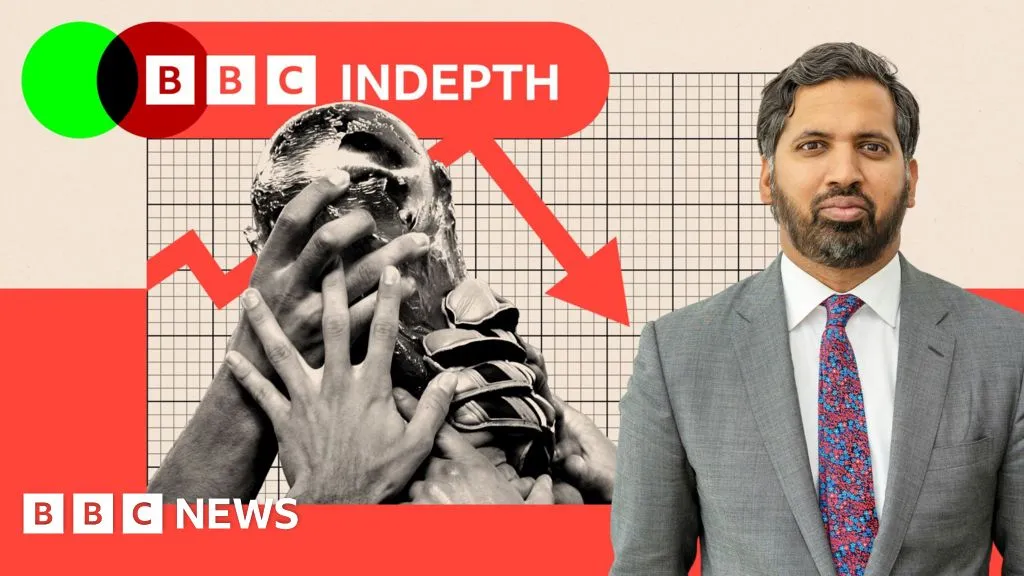
The 2026 World Cup is unlike any prior tournament, taking place against a backdrop filled with geopolitical tension, economic disparity, and skyrocketing ticket prices. As the world's attention shifts to the beautiful game, it also showcases a significant moment in the evolution of our global economy, as explored in Faisal Islam's in-depth analysis.
Geopolitical Tensions Ignite a Unique Tournament
The hosting of the World Cup in the United States, Canada, and Mexico unfolds amidst an ongoing war between the U.S. and Iran, straining the fabric of international relations. As teams prepare for their matches, one participant must travel from a neighboring country to compete, illustrating a rare and dangerous scenario for the sport.
Adding another layer of complexity, the co-hosts find themselves entwined in a tumultuous trade war, with ongoing negotiations of the United States-Mexico-Canada Agreement (USMCA) coinciding with the tournament's timeline. President Donald Trump, recently returned to the White House, has signaled the importance he places on the World Cup, asserting that his political comeback enhances America's role on the global stage.
Economic Shockwaves Reverberate
The implications of these conflicts extend far beyond the soccer pitch. Trump’s previous military actions and attempts to broker a peace deal could drastically affect energy prices and consumer confidence worldwide. With potential US-Iran matchups looming in the knockout stages, the tournament bears witness to history in the making, enriching the stakes beyond mere athleticism.
A Financial Strain on Fans
However, the fans attending this unprecedented World Cup are feeling squeezed. Jock Stein's famous assertion, "Football is nothing without the fans," feels increasingly hollow as supporters are confronted with unprecedented ticket prices and commuting costs. The price to travel to a game can soar from the regular $12.90 to an astonishing $100, reflecting a financial model that seems unsustainable for many.
A Transformative Economic Landscape
FIFA's ambition for the tournament emphasizes high revenues but risks alienating the very fans who make the sport what it is. This model mirrors the K-shaped economic recovery observed in many advanced nations, where different segments of society find themselves on divergent financial paths. FIFA has assured that profits will be redirected to cultivate football in underprivileged regions, yet the stark realities faced by ordinary fans in the stadiums punctuate a marked disconnection.
Impact Beyond the Field
This World Cup stands not just as a sporting event, but as a reflection of current global dynamics, illustrating conflicts, economic challenges, and opportunities for growth. As fans navigate these turbulent waters, the beautiful game continues to serve as a mirror to the world's complexities. Indeed, this could transform into one of the most impactful tournaments in history, reshaping the future of football and its economic implications.
Source: BBC News
Source: BBC News - Business